
- AI/UX
- AI Chat
- Conversation design
- Enterprise
Designing AI agents patients and staff actually trust
Designed Televox's Chatbot/Agent experience and led the design for new flagship AI Agent building platform.
At a glance
Role
Lead product designer - AI platform and agent experiences
Collaborators
- Product management
- ML/AI engineering
- Conversation design
- Clinical SMEs
Timeline
Ongoing
Impact
- Design lead for the flagship AI platform and its agent chat surfaces
Context
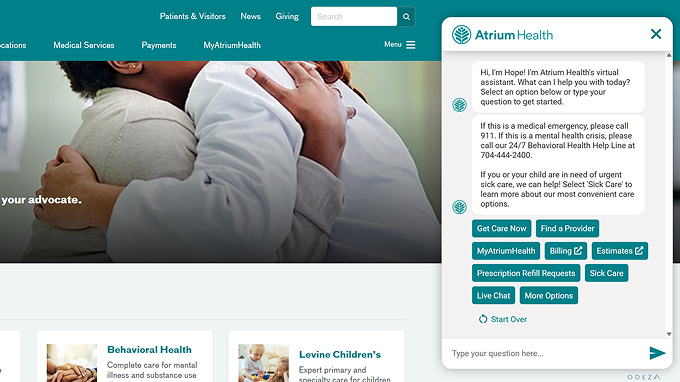
One of Televox's key features was the Chatbot/Agent Chat, where patients could navigate intents and get solutions to their needs or speak with a live agent. The goal was alleviate call center volumes, which Chat was successful in doing.
The problem space was that the intents still had limitations, leading patients to either different pages or speaking to a live agent, causing rising queue times.
The goal of the AI platform was to leverage LLMs and knowledgebase for health systems to create customize AI agents equipped with skills to answer more sophisticated questions and complicated tasks.
Key decision 01
Give clients a way to build and trust their own agents
The platform needed to let non-technical hospital teams assemble an AI agent from their own knowledgebase and a set of skills, without writing prompts from scratch.
The configuration flow was structured around three questions
- What can this agent answer?
- Where does it get its answers?
- When does it hand off to a human?
Escalation and uncertainty were designed as first-class states rather than error cases. When confidence is low or an intent falls outside the agent's skills, the conversation transitions to a live agent with full context carried over, so the patient never repeats themselves.
Key decision 02
Designing the agent builder around what an agent actually needs
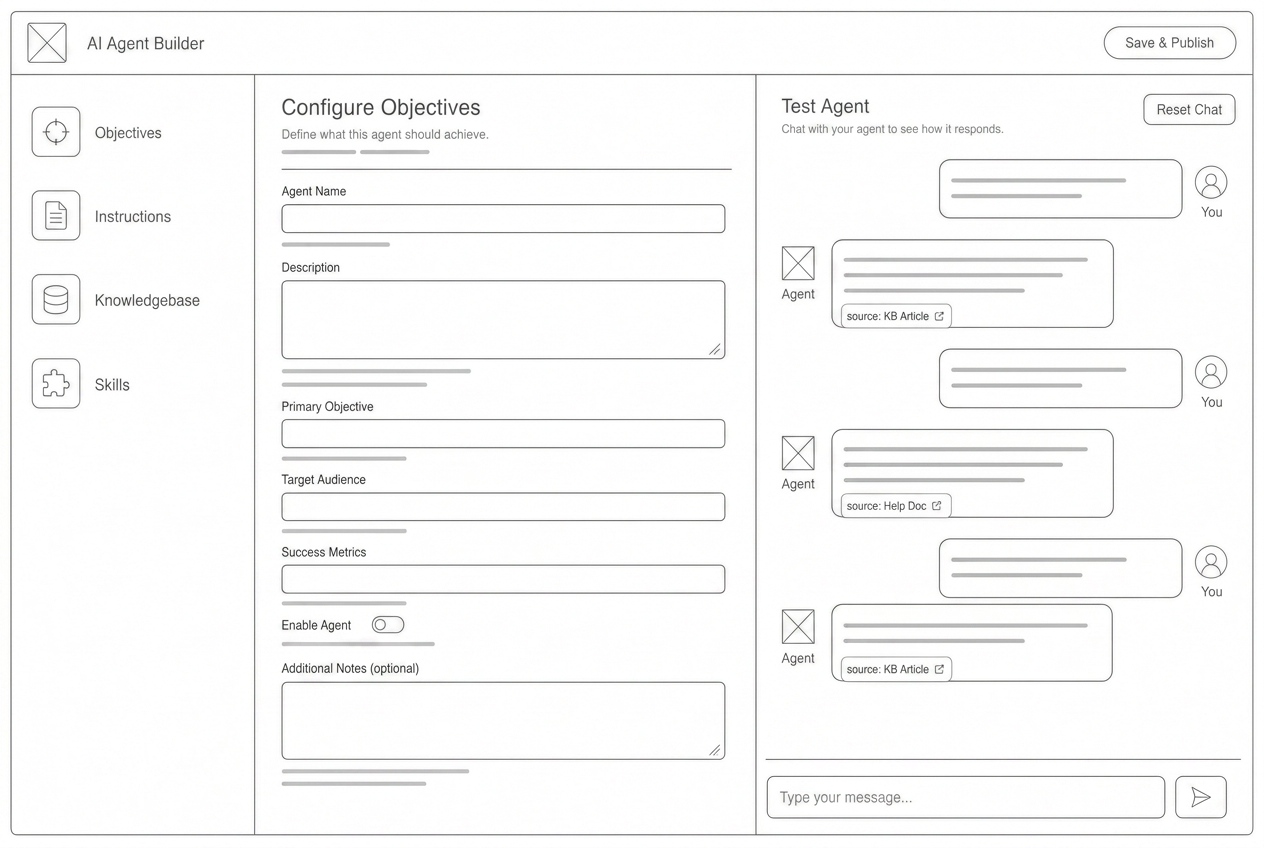
Building an AI agent is not a form, it is a set of decisions. I anchored the platform on the four inputs a client has to get right before an agent can go live:
- Objectives: what this agent is responsible for, written in plain language, which frames every other choice in the builder.
- Instructions: tone, boundaries, and escalation rules, authored as guidance rather than raw prompt text.
- Knowledgebase: which sources the agent may answer from, with visibility into what is connected and what is stale.
- Skills: the concrete tasks the agent can perform, scoped so a client can add capability incrementally.
The builder presents these as a persistent left-hand structure rather than a linear wizard, because configuration is never finished. Clients return to tune instructions or swap sources long after launch, and the layout had to make that ongoing work feel routine instead of like a re-setup.
Paired with the configuration is a system output window: a live test surface where the client talks to the agent as it is currently configured, and sees not just the reply but why it answered that way, which source was used, and where confidence dropped. That feedback loop was the piece that made the platform trustworthy. Without it, clients were tuning blind and had no way to tell a knowledge gap from an instruction problem.
Key decision 03
A design system of its own, built on shadcn and Tailwind
The AI platform was a new product, not a module of the enterprise suite. It needed its own identity: a forward-looking surface that signaled a different class of capability, without inheriting a decade of legacy patterns from the flagship platform.
Rather than extend the existing component library, I stood up a separate design system with shadcn/ui and Tailwind CSS as the base. That gave us primitives we owned outright and a token layer we could theme independently, so the platform could look and behave like itself while still meeting the same accessibility bar.
What the new foundation gave us
- Independent identity: its own type scale, color tokens, and density, distinct from the enterprise product.
- Speed: unstyled, accessible primitives meant new AI-specific patterns like the output window and skill cards could be composed in days rather than negotiated into an old library.
- Ownership: components live in the codebase, so the team could adapt them to conversational and streaming UI instead of fighting a vendor's assumptions.
The tradeoff was two systems to maintain. I mitigated it by keeping shared semantics, naming, spacing logic, and accessibility rules aligned with the enterprise system, so a designer or engineer moving between products recognizes the grammar even when the visuals differ.
Outcome
Due to a restructuring, the AI platform was taken over by the parent company shortly after my design work. I don't have access to the post-launch KPIs.