- Healthcare SaaS
- 0→1
- Award winner
Shrinking an enterprise healthcare platform down to something a small front desk can run
Ideation to shipped V1 in 3 months and winner of Best Practice Management Solution at the 2025 MedTech Breakthrough Awards.
At a glance
Role
Lead product designer - end-to-end, discovery through shipped V1
Collaborators
- Product manager
- Engineering lead + 4 engineers
- Clinical operations SME
- Implementation & support leads
Timeline
3 months, ideation to V1 (2024–2025)
Impact
- Shipped V1 in three months with a small cross-functional team
- Named Best Practice Management Solution, 2025 MedTech Breakthrough Awards
- Brought an enterprise platform serving 200+ hospitals and clinics
Context
The flagship enterprise platform was built for large health systems with complex workflows and configurations to handle the large scale of patients in a hospital system. Though effective for large systems, this platform left a large demographic of small local practices across the nation unaddressed.
Small practices wanted the same outcomes with fewer no-shows, less phone volume, and faster intake but the enterprise platform was too complex and was not applicable for a small practice with exponentially lower staff and patient counts.
Practice Edition was the new platform set out to give functionalities of the enterprise platform but to simplify the experience to cater small local practices with minimal staff and less technical literacy.
Constraints
- Three months from ideation to a shippable V1, with no new backend services.
- The underlying platform's data model and messaging engine could not change.
- No implementation team, no training. Setup had to be finishable by a non-technical user in a single sitting.
Key decision 01
Cut the surface to the jobs a front desk actually does in a day
Rather than porting features and hiding the extras, I mapped the enterprise product against a day in a two-provider practice and kept only what appeared in that day: confirm, remind, reschedule, recall, and answer.
Everything else moved behind a single settings surface or out of V1 entirely. Instead of hoping between multiple features for a single workflow, staff members can perform their intended task on one page.
Key decision 02
One dashboard, split by what is waiting on a human
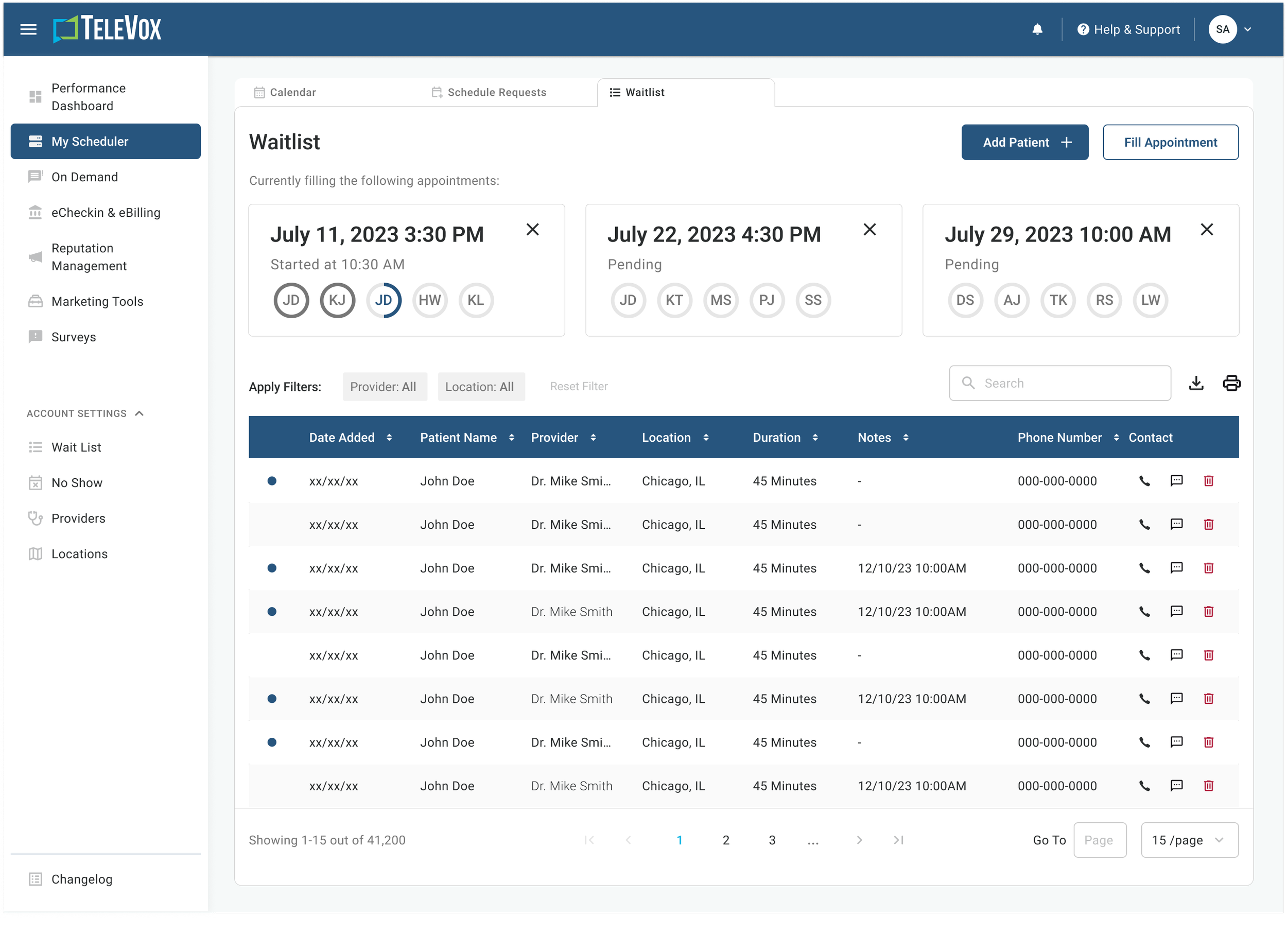
Enterprise users navigate by module. Small-practice users navigate by urgency. The dashboard splits the screen into what the system has handled and what still needs a person, so an untrained user always knows where to look first.
Key decision 04
Setup as a first session, not an implementation
Onboarding was reframed from configuration to a guided first hour: connect the schedule, confirm hours, pick the three messages that matter, send a test to yourself.
Anything not required to send a first correct message was deferred to a settings surface the practice could grow into.
Outcome
- Ideation to shipped V1
- 3 monthsIdeation to shipped V1
- MedTech Breakthrough Award winner
- 2025MedTech Breakthrough Award winner
- Hospitals & clinics on the platform
- 200+Hospitals & clinics on the platform
- Implementation projects required
- 0Implementation projects required

Best Practice Management Solution - 2025 MedTech Breakthrough Awards
Reflection
The instinct on a scaled down product is to hide complexity. What worked here was deleting it and deciding at the workflow level what a small practice would never do, and refusing to carry those affordances forward.
If I ran it again, I would put the outbound-messaging safeguards into usability testing earlier. They were the right call, but we validated them late in a timeline that left little room to be wrong.